HapticPad 1.8 Cracked Version – Haptic Enhancement for Mac Trackpad Web Browsing
Introduction
HapticPad is a tool for macOS that enhances haptic feedback on the trackpad. It translates interactive elements on web pages—such as links, buttons, and input fields—into subtle vibrations on a Force Touch trackpad, allowing you to browse the web without relying solely on visual cues. It works in conjunction with a Mac app and either a Safari extension or a Chrome extension. When the cursor hovers over a clickable or input-ready area, the extension instantly identifies the element type and triggers a haptic pulse via a local connection to the desktop app, with a response latency of less than 10 milliseconds—providing a sensation that closely mimics natural reflexes.
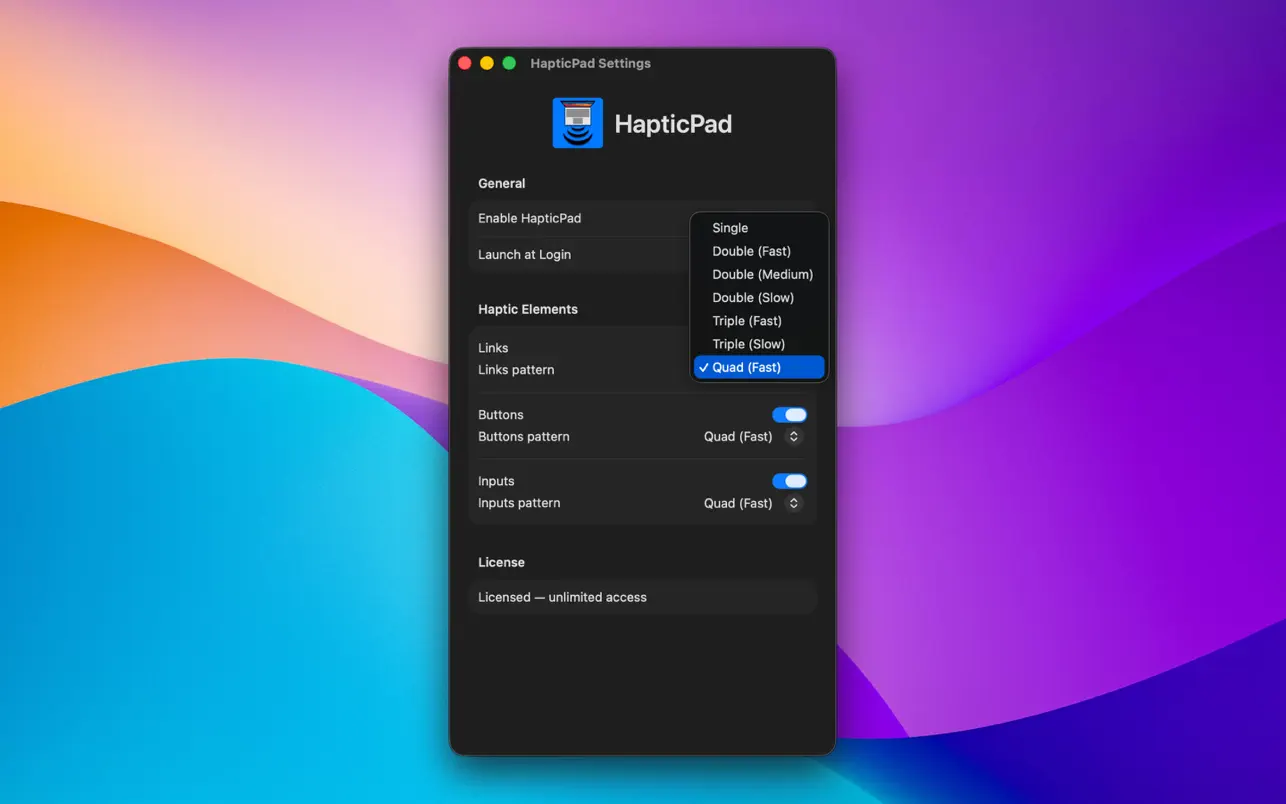
The software offers seven configurable haptic modes and supports setting single-click, double-click, triple-tap, or quadruple-tap feedback for links, buttons, and input fields separately, allowing users to customize haptic cues according to their browsing habits. HapticPad prioritizes local operation and privacy protection; it transmits only element types and does not upload URLs, page content, keyboard input, or analytical data, making it ideal for Mac users who wish to enhance the perceptibility of web interactions, browsing efficiency, and the overall interactive feedback experience.
Screenshots
Features
HapticPad is a productivity tool that integrates the Mac Force Touch trackpad into web browsing interactions. Through a browser extension, it identifies links, buttons, and input fields on web pages and triggers quick haptic feedback when the cursor hovers over them, allowing users to determine the type of page element by touch as they move the cursor. It is ideal for users who do a lot of web browsing, office research, and online form filling, as well as those who want to enhance their Mac touch experience.
- Web Haptic Feedback: When the mouse pointer hovers over a link, button, or input field, HapticPad emits a haptic pulse through the Force Touch trackpad, making interactive web elements perceptible and reducing the burden of relying solely on visual recognition.
- Low-Latency Response: After the extension detects an interactive element, it notifies the Mac application via a local connection to trigger feedback. With an overall response latency of less than 10 milliseconds, the haptic feedback occurs quickly enough that it feels like instant feedback rather than a delayed notification while browsing.
- Safari and Chrome Support: The software includes a Safari extension and is compatible with a separately installable Chrome extension, covering common web browsing scenarios and providing users with a consistent trackpad feedback experience across different browsers.
- Multiple Haptic Modes: Seven built-in, configurable feedback styles are included, such as single tap, double-tap at different speeds, triple-tap at different speeds, and quadruple-tap, making it easy to establish a distinct haptic language for different elements.
- Independent Element Configuration: Links, buttons, and input fields can each be assigned different vibration modes. Users can customize feedback rules in the settings panel according to their personal preferences—for example, setting more prominent prompts for form inputs and lighter feedback for regular links.
- Local Privacy Protection: The extension only transmits element type information to Mac applications; it does not transmit URLs, web page content, input data, or analytical data, nor does it rely on remote servers. All interactions are processed locally.
- Improved Browsing Efficiency: By using haptic feedback to confirm clickable and input areas, users can more quickly identify actionable elements when browsing complex webpages, backend management pages, online tools, or document systems, reducing the need for repeated checking and accidental clicks.
- Lightweight Design: The app is compact and focuses on its core function—trackpad haptic feedback—without introducing complex interfaces or additional processes, making it ideal as a long-running web interaction assistant.
- Clear Hardware Requirements: Requires a Mac with a Force Touch trackpad or a Magic Trackpad, as well as macOS 13 Ventura or later, to fully utilize the native haptic capabilities of Apple’s trackpads.
Recent Posts